SEO Control is an internal SurfUp product shaped by agency work: as the team takes on more projects, repetitive checks of rankings, indexing, technical issues and webmaster-service changes consume more time. We turned that experience into a service now used in the studio’s daily work and also available as a standalone product. It develops independently and connects to SurfUp app through an API integration that limits each user’s access to their own data.
Reduce repetitive checks and spot search-visibility changes sooner.
Managers should not have to visit webmaster services and analytics by hand for every project. Signals should come to them, while change history is saved automatically.
We built the service around three layers: data collection, automated checks and delivery of signals to the people who need them.
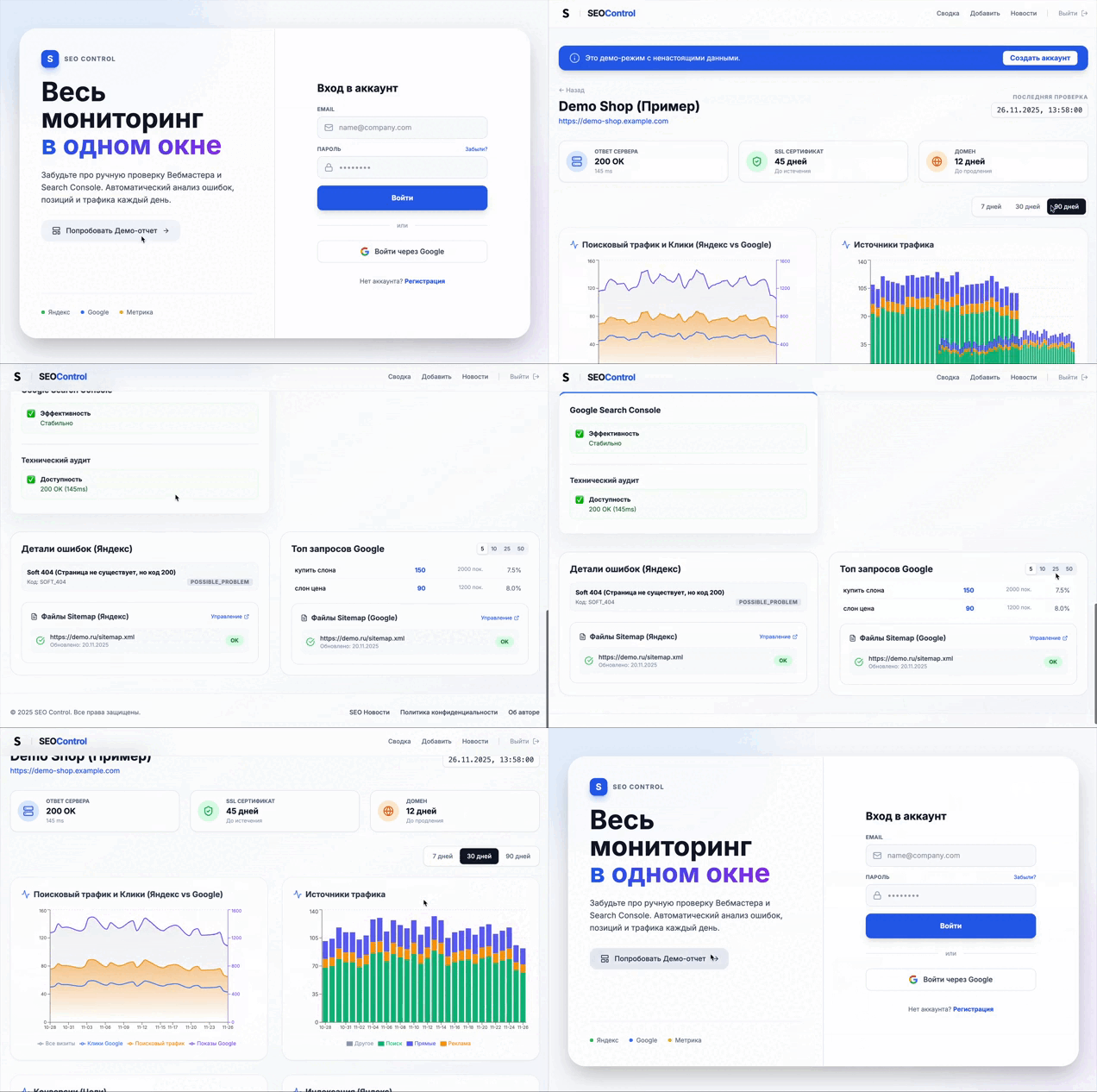
- Built a separate SaaS interface and monitoring workflows for projects, dashboards and resource-level change history.
- Integrated webmaster-service and analytics data, including search impressions and clicks, technical reports and page-level trends.
- Added automated technical checks for availability, redirects, metadata and changes on critical pages.
- Built notifications so significant changes reach the responsible people promptly, with thresholds configurable for each project.
- Created project reports that compile regular summaries from accumulated data without manual assembly.
- Structured integrations so SurfUp uses an API that limits each user’s access to their own data, keeping data and permissions separate.
The key decision was to use signals instead of periodic manual checks. The service does not just show a weekly report: it continually compares current metrics with baseline levels and raises an alert when a threshold is crossed. That changes how the agency spends time—people step in when a signal is confirmed.
SEO Control replaced daily manual checks with automated monitoring: coverage reached 50+ projects, and visibility-drop alerts arrived within minutes instead of waiting for a reporting cycle.
| Metric | Result |
|---|---|
| Routine checks | Reduced by 90% |
| Projects monitored | 50+ |
| Visibility-drop detection | Days → minutes |
| Regular client reports | Manual assembly → automated summaries |
Metrics are transcribed from the original case materials. A period is stated where it is recorded in the source.
The product is developing in these areas:
- Add GEO signals to monitor brand mentions in AI service answers alongside traditional search visibility.
- Create industry-specific threshold profiles for e-commerce, healthcare and B2B.
- Offer a client API to send signals and metrics into client teams’ internal systems.
Related source: Source case