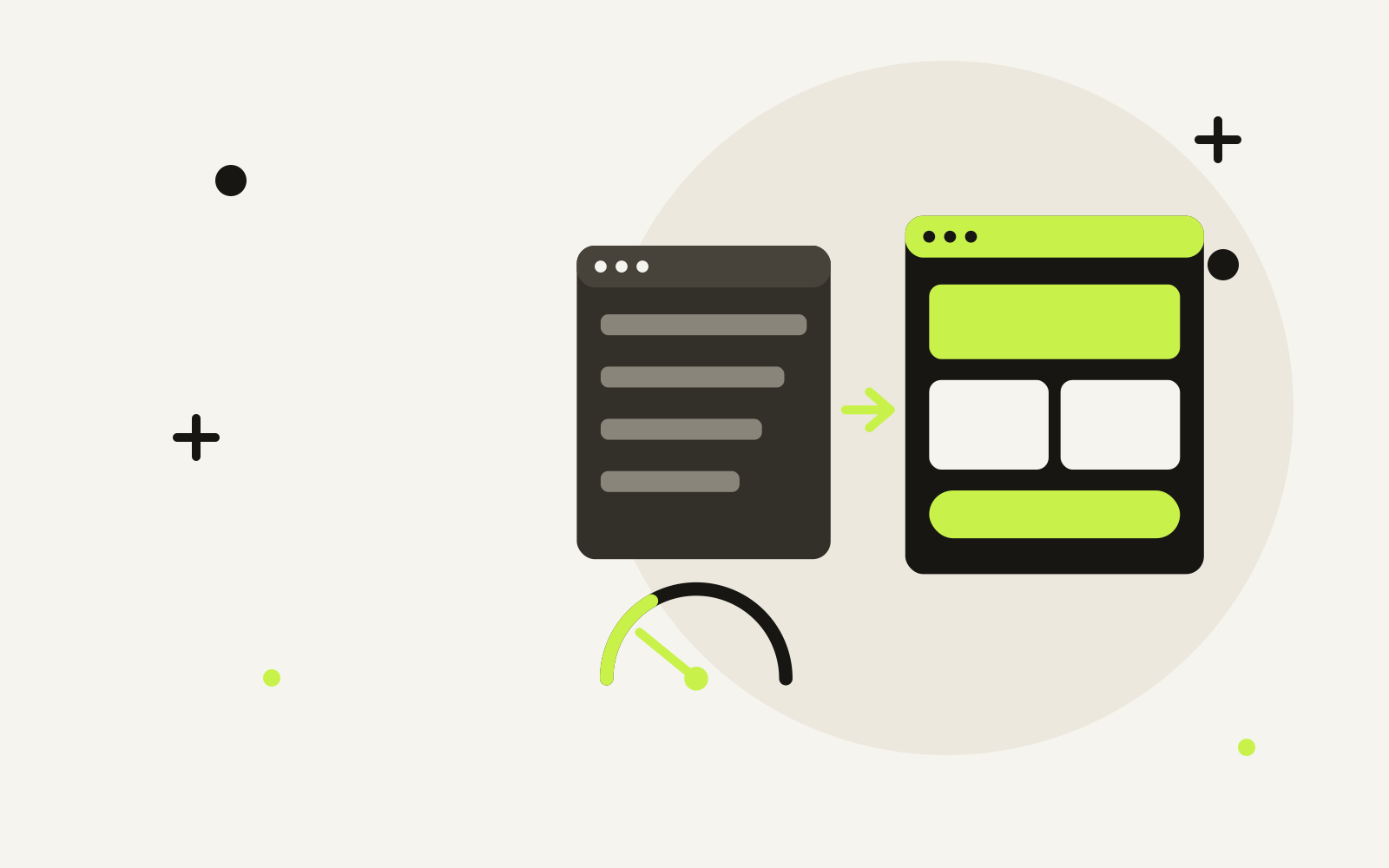
The client is an insurance company selling compulsory motor liability insurance, comprehensive motor insurance and travel products online. Its platform had been built over many years: custom PHP, lost documentation, changes taking several weeks and 11 critical vulnerabilities identified in an external audit. The website is its main sales channel, with tens of thousands of indexed pages in a YMYL field subject to strict content-quality requirements. Any migration error could mean losing search rankings that are very costly to regain in insurance.
Move the website and online policy purchase flow to a modern stack without stopping sales for a single day:
retain search traffic, close vulnerabilities, speed up the platform and let the team develop the product without fear of breaking something. The board’s bonus requirement was for the project to pay for itself through higher conversion, not just “technical housekeeping”.
We broke the migration into stages that could be switched independently: content pages first, then calculators and policy purchase, and the personal account last. Each stage could be rolled back separately, so risk accumulated in portions rather than all at once.
- Inventoried the platform: crawled every URL, mapped functionality, listed integrations with payment and accounting systems, and prioritized pages by traffic and revenue.
- Designed the target architecture: a Next.js frontend with server rendering for search pages, an API layer over existing services and a phased retirement of legacy code.
- Migrated content pages: created a redirect map for 80,000 URLs, moved metadata and markup, and checked every page against the original for content and structure.
- Rewrote online policy purchase: calculator, purchase steps and payment, with old and new versions running in parallel on part of the traffic.
- Shifted traffic using a canary approach—5% → 25% → 100%—checking errors, conversion and rankings at every step.
- Kept a rollback plan for each stage: if metrics degraded, traffic could return to the old platform in minutes, not hours.
SEO migration safety ran as a separate workstream: daily checks of indexing, rankings for priority clusters and crawl errors, and comparison of traffic with the previous year. This discipline restored organic traffic steadily in two weeks instead of the months-long “dip” typical of projects like this. The board got what it asked for: a faster platform and protection for the sales channel in one project.
The 34% conversion increase came directly from speed and a simpler purchase process. Conversion grew most on mobile, where a seven-second load used to kill the sale. For the business, that means dozens of additional policies a day without expanding the advertising budget; according to the client’s calculations, the migration paid for itself in one quarter. Another effect is development speed: features that used to take weeks now ship in days.
| Metric | Result |
|---|---|
| Load time (LCP) | 6.8 s → 1.4 s |
| Policy purchase conversion | +34% |
| Critical vulnerabilities | 11 → 0 |
| Organic traffic | Recovered in 2 weeks, then continued growing |
Metrics are transcribed from the original case materials. A period is stated where it is recorded in the source.
- LCP load time (was 6.8 s)
- 1.4 s
- policy checkout conversion
- +34%
- critical vulnerabilities (was 11)
- 0
- to recover organic traffic
- 2 weeks
Each step is checked against errors, conversion and rankings, with a rollback plan.
- 01Content pagesredirect map for 80 thousand URLs
- 02Calculators and checkoutold and new versions in parallel
- 03Account arealast
What the new stack makes possible:
- A headless CMS so marketing can publish insurance-product landing pages independently, without developers.
- An A/B testing platform to make policy-purchase experiments an ongoing process rather than a one-off project.
- Personalization of offers by vehicle type, region and customer history.
For three years we hesitated to migrate—we were afraid of losing traffic and sales. In the end, there was not a single day of downtime, and conversion rose by a third.
— Digital Channels Director at the Insurance Company